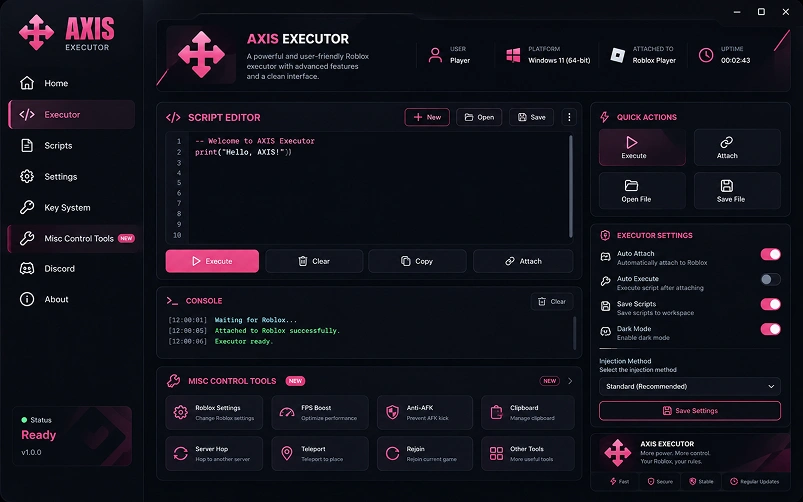
Misc Toolbelt
01A pinned strip for the toggles you fire off constantly — noclip, gravity slider, jump multiplier, teleport pins and a hard-stop switch that clears every active script in one press.
Axis External boots in under a second, snaps onto any live Roblox process, and hands you a paste-and-fire workspace. Command palette, custom hotkeys, signed script vault — one client across every device you own.
Six modules the Axis External build actually leans on during a session. Every one is a shipping feature — not a marketing tile.
Cold-start averages 780 ms on desktop. The runtime warms its symbol tables in the background so the first script fires without a spin-up delay.
Every launch generates a fresh session identifier. The old fingerprint is discarded on close, so back-to-back sessions never share the same trace.
Ctrl+K opens a fuzzy search across every script, setting and vault entry in Axis External — jump straight to what you need instead of digging through tabs.
Run up to four separate clients side-by-side, each with its own account state and hotkey map. Ideal for multi-boxing farmers or comparing scripts against a control window.
Bind any script, toggle or command to any key or mouse chord — including scroll and side buttons. Profiles save per-game so binds don't collide.
Every vault entry ships with a SHA-256 hash. The runtime verifies each script against the manifest before execution — tampered files never load.
Four platforms, four short flows. Pick your device — each tab lists the exact taps or clicks between the Axis Executor download button and your first fired script on the Axis External runtime.
After the download finishes, right-click the file, hit Properties, then compare the SHA-256 against the hash printed on this page. A match confirms you have the untouched build.
Open Defender's exclusion list and add both the install folder and the client's .exe as a process exception. This stops real-time scanning from touching runtime memory.
Boot Roblox from your launcher of choice and enter any experience — the empty menu doesn't expose the process the attach step needs.
Head to Settings → Hotkeys and pick the key you want to trigger paste-and-fire. F5 is the default, but any keyboard chord (or mouse button) is accepted.
The download page auto-serves the universal binary — same file for Apple Silicon and Intel machines. Drop it into Applications so the auto-updater can replace it in place later.
First launch throws a Gatekeeper prompt because the certificate is new to your machine. Right-click the app, hit Open, and confirm — macOS remembers the choice for every future launch.
Under Privacy & Security, tick Input Monitoring for the client. Without it, macOS silently blocks the global hotkey listener and paste-and-fire won't respond.
Load into a Roblox experience before hitting Attach. The client polls for the game process, and the menu screen doesn't count — it has to be inside a live place.
Head to Settings → Apps → Special access → Install unknown apps and grant permission to your browser. Android needs this one toggle before it will accept a sideloaded package.
Tap the downloaded .apk from your notification tray, confirm the install prompt, and wait for the green tick. The Play Store isn't involved in this flow at all.
Under Apps → Axis → Display over other apps, flip the switch on. This is what lets the floating attach bubble stay visible while Roblox holds fullscreen focus.
Long-press the app icon on your home screen — the shortcut menu exposes a one-tap Attach action that skips the splash and jumps straight into the workspace.
Only Safari can serve the configuration profile that carries the iOS build. Chrome, Firefox and in-app browsers all get rejected by iOS at the trust step.
Once the profile installs, open Settings → General → VPN & Device Management. Tap the Axis certificate, then Trust — iOS remembers the decision until the certificate expires.
Sideloaded iOS builds expire seven days after signing. When yours does, revisit the site in Safari and reinstall — settings, vault pins and hotkeys survive the re-sign.
Long-swipe left from your home screen to open Widgets — the Axis tile has an Attach button that skips launching the app entirely.
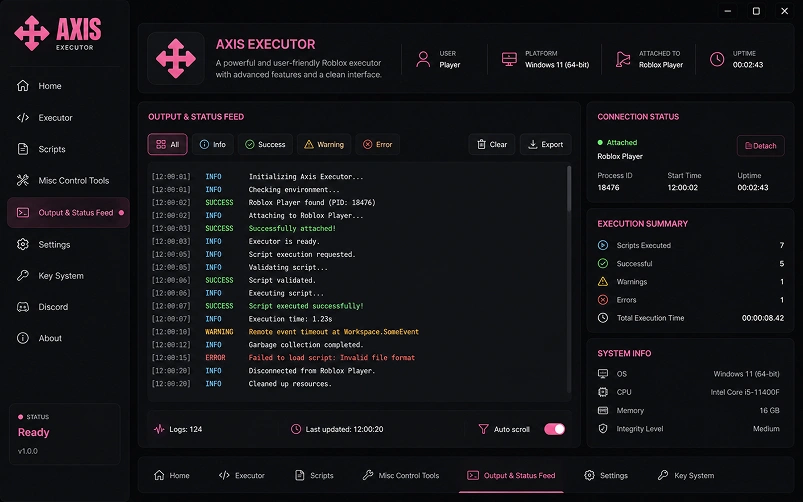
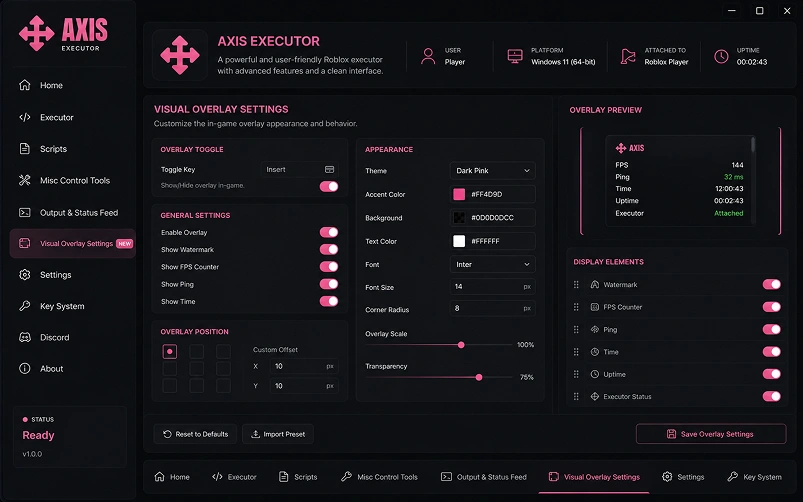
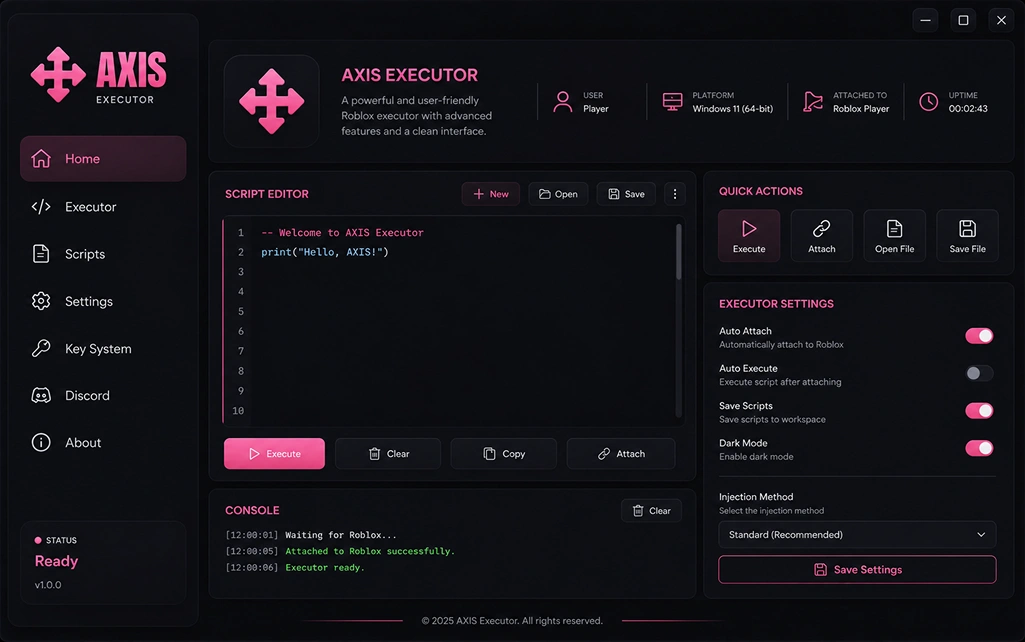
Three panels you'll spend the most time in inside Axis External — the misc rail on the left, the runtime console dead-centre, and the overlay editor on the right. Screenshots are pulled straight from the current Axis Executor build.
A pinned strip for the toggles you fire off constantly — noclip, gravity slider, jump multiplier, teleport pins and a hard-stop switch that clears every active script in one press.
Every attach event, print call and Lua exception lands here with a timestamp, severity tag and a jump-to-line shortcut. Errors highlight red, warnings amber, prints white.
Compose overlays inline — box, tracer, cham and label toggles per target class, with a live preview so you see the change on-screen the moment you flip a switch.
Every shipped build of the Axis External client, in reverse order. Pick a version on the left to see what was added, fixed, improved or removed — dates, platform coverage and file-touch counts are on each entry.
Fuzzy search across scripts, settings and vault entries — with jump-to-line for open editors.
Up to four parallel client windows with independent hotkey maps and account state. Left beta this cycle.
Every entry now ships with a SHA-256 hash. The runtime verifies each script against the manifest before load — tampered files never execute.
Rewritten out-of-process handshake fails fast instead of hanging. Median attach dropped from 21 ms to 12 ms on desktop.
The search index now invalidates on every library sweep instead of on client restart.
Console output is now virtualised — dumping a large table no longer freezes the render thread for 3–4 seconds.
Bottom panel no longer overlaps the chat field on notched iOS and Android devices.
Spammy binds now register one-to-one. Trigger-frequency binds feel responsive again.
Runtime entries can be copied one at a time instead of only via full dump.
The floating overlay renderer now backs off gracefully when the OS raises memory pressure warnings.
Three-axis filter row above the library. Pinned entries stay above the fold regardless of the filter.
Regex-aware find and replace inside the script editor, with match count in the gutter.
The client no longer polls for game state while minimised. Battery impact on laptops is visibly lower.
The 3.x runtime shim was retired. Scripts written against pre-4.0 APIs need a one-time update pass.
Vault entries were previously served over TLS but not signed at rest. Signing keys are now rotated per release; unsigned entries are refused by the runtime.
The updater now pins the CDN certificate and refuses to install unsigned or downgraded builds.
Race condition in the log writer when rotating a 50MB+ file. Traced and closed.
Workspace / Vault / Console / Settings each get their own tab with browser-style back/forward navigation.
Pinned scripts, hotkey maps and vault filters sync between desktop and mobile through one optional account.
Community modules can register overlays and side-tools without patching the client binary.
The 3.x shell was retired. Reopening a legacy layout via --legacy is not supported past this release.
Teleport, server-hop and rejoin flows re-arm the last-running script set automatically.
Reworked handle acquisition to match the 24H2 kernel change. Attach reliability on 24H2 back to 100%.
The floating overlay no longer flickers when Roblox is dragged between monitors of different refresh rates.
Last tuning pass on the legacy engine before it was retired in 4.0.
Final round of 3.x crash fixes tied to the 24H2 update cycle.
Initial beta of pinned-script sync between desktop and mobile. Later stabilised in 4.0.
APK signature block was rejected by newer Android builds; regenerated with an updated toolchain.
The vault covers the games people actually load into: farmers, PvP arenas, tower defense, survival and simulators. The list below is a slice — the full library on the axis external roblox client sits at just over 2,400 scripts and is refreshed weekly.
Timed planting cycles, growth-aware harvesters and shop-run macros that stay within reasonable input rates.
Deflect windowing, prediction-based target lock and a configurable perfect-parry delay for round consistency.
Path pinning between safe zones, ammo/health thresholds and an auto-return trigger when the train peaks.
Wave macros, unit placement templates by stage, and an auto-re-enter loop for the current story mission.
Level-brackets aware questing, sea event pings, fruit spawn notifiers and a raid queue for the top three islands.
Wave-scaled placement templates, coin routing between rounds and a fallback strategy when your setup breaks under a hard wave.
Egg cycling, collection-priority macros and gem farm routes tuned to the current event map.
Da Hood, Fisch, Brookhaven, Murder Mystery 2, Arsenal, Bee Swarm — the current bundle covers the top hundred games in one archive.
The axis external roblox build lined up against the five names people ask about most — scored across eight axes reviewers actually care about, with the latest tested version of each.
| Executor | Attach Time |
Interface | Ease of Use |
Feature Structure |
Update Cadence |
Mobile Support |
Keyless | Rating | Overall |
|---|---|---|---|---|---|---|---|---|---|
|
01
Axis
Recommended
|
12ms | Excellent | Very Easy | Well Organized | 10–14d | Full | ✓ |
★★★★★
4.9 · 2,341
|
9.6
/ 10
|
|
02
Wave
Stable
|
28ms | Good | Easy | Average | ~3 weeks | Partial | ✓ |
★★★★★
4.2 · 1,180
|
8.1/ 10
|
|
03
Zenith
Stable
|
34ms | Mixed | Moderate | Uneven | ~1 month | None | ✓ |
★★★★★
3.8 · 942
|
7.4/ 10
|
|
04
Synapse X
Paid · $20
|
18ms | Good | Moderate | Solid | ~5 weeks | None | ✕ |
★★★★★
3.6 · 2,010
|
7.1/ 10
|
|
05
Nova
Slow updates
|
62ms | Outdated | Harder | Messy | 2+ months | Partial | ✓ |
★★★★★
2.9 · 480
|
6.2/ 10
|
|
06
JJSploit
Deprecated
|
85ms | Dated | Easy | Basic | Sporadic | None | ✓ |
★★★★★
2.5 · 1,720
|
5.4/ 10
|
Scores are aggregated from side-by-side testing on Roblox 2.6.x (Aug 2026) across the same reference PC and phone. Attach time is the median of 100 cold-starts. Ratings are averaged from public feedback threads and in-client submissions.
The runtime issues that come up most in the community channel, grouped by which subsystem they hit. Filter by type on the left, expand the row to see the fix.
The client is reaching the internet fine but can't resolve the vault endpoint. Nine times out of ten this is a DNS setting inherited from a VPN or a school network — the fix is a manual DNS override.
Almost always a network hiccup between the client and the Roblox process — the runtime marks the attach as stale after four seconds of no response and drops it deliberately.
Roblox grabs exclusive keyboard focus in full-screen mode, which cuts off any global hotkey listener sitting in the background. Two paths fix this — either drop full-screen, or switch to raw-input capture.
By default the runtime caches every script output and every attach snapshot. Over a 4-hour session that can climb past 800 MB — not a leak, just cache pressure. There's a switch for it.
An empty vault almost always means the local cache went stale — a common side-effect of a fresh install or a build downgrade. Force a rebuild and everything reappears in under a minute.
Sync runs off the account link, not the local device. If pins aren't appearing on your other device it's usually because the two clients are signed into different accounts — or one hasn't checked in since the last pin.
The overlay uses vsync from whichever monitor Roblox is on. When your two displays run at different refresh rates (say 144 Hz and 60 Hz) and Roblox spans across them, the overlay picks the wrong clock and stutters.
On phones with a notched or punch-hole display, the OS status bar overlaps the top edge of the panel and clips the tab strip. Newer Android builds don't report the safe-inset area to sideloaded overlays automatically.
Sideloaded iOS builds ship on a certificate that Apple caps at seven days for free developer accounts. When the certificate lapses, iOS refuses to launch the app until it's re-signed.
Six questions the community channel receives on repeat. If yours isn't listed, the mods on Discord tend to answer inside an hour.
Point releases ship on a two-week cadence; hotfixes go out same-day whenever Roblox pushes a runtime change that breaks attach. The client checks for a newer build every launch and applies the delta silently — a full reinstall is only needed on major shell version bumps.
Yes — the Axis External workspace has a Local tab beside the vault. Drop any .lua file into that tab and it lands as an editable card with its own pin, hotkey slot and history.
A game-side ban is separate from anything the client does — it's Roblox's anti-cheat responding to observed behaviour. Use a burner for anything visibly aggressive (teleport, aimbot, speed), and keep your main clean for less obvious utilities. The Axis External account itself is never at risk from a Roblox action.
Pinned scripts do — they cache locally on first execution and stay runnable without a connection. Unpinned vault entries need a live connection because the runtime verifies their manifest hash on load. Pin anything you'd want during a flight or on cellular deadzones.
Uninstalling the Axis Executor wipes the install folder, but a few directories outside it hold user data — pins, hotkey profiles, cached scripts and log history. All of them are safe to delete manually if you want a fully clean removal.
Every release publishes a SHA-256 hash on the download page. Compute the hash of the file you downloaded (PowerShell: Get-FileHash; macOS: shasum -a 256) and compare byte-for-byte. A mismatch means a repackaged copy — the official build is served exclusively from axisexecutor.com.